




The Justice Development and Peace Makers Centre (JDPMC), Osogbo, has alleged that vote buying was widespread during the just-concluded Osun State governorship election, while security agencies failed to make arrests despite several incidents of electoral violence recorded across the state.
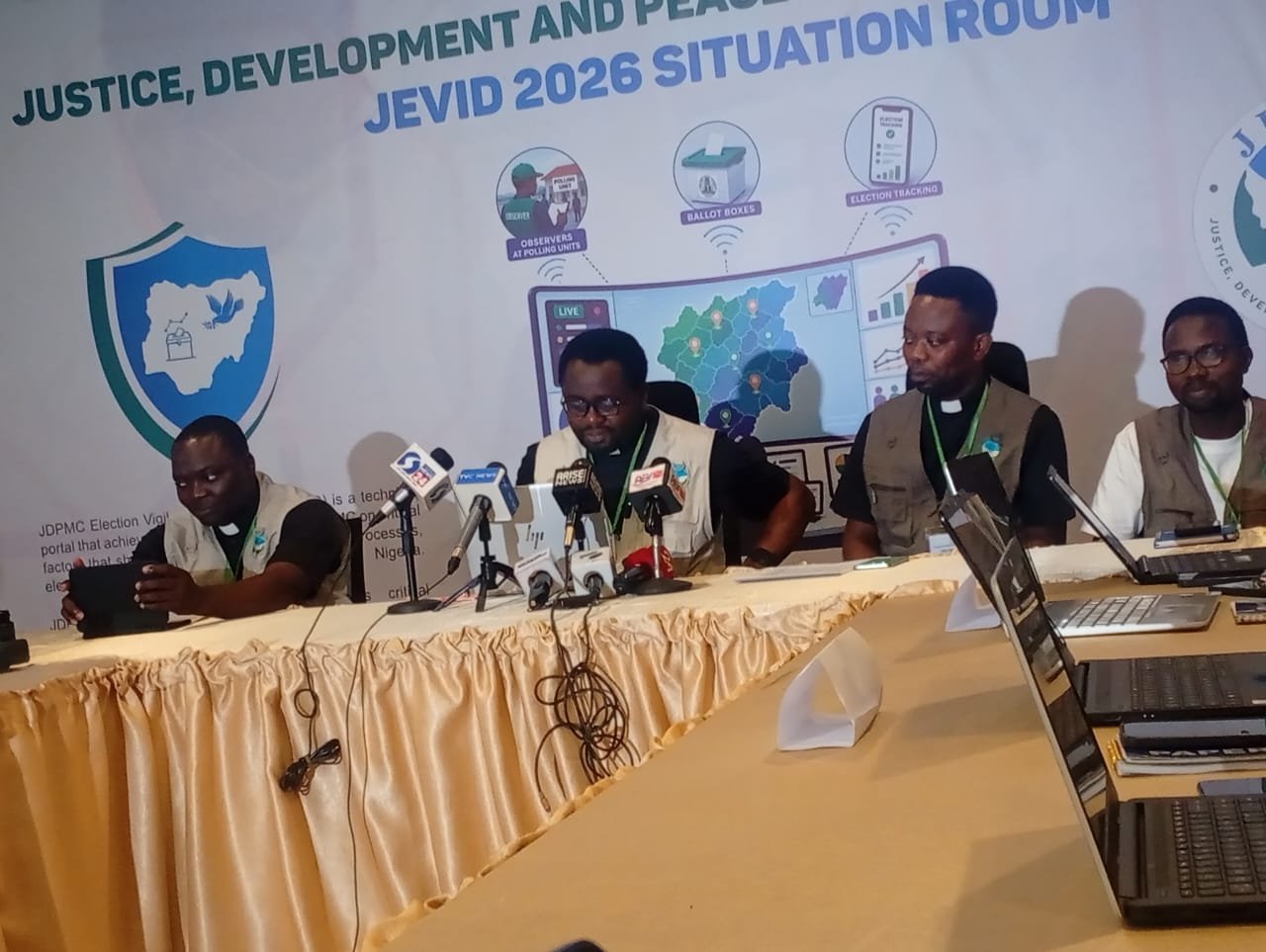
The organisation made the disclosure during a press conference addressed by its General Coordinator, Rev. Fr. Peter Akinkunmi, who signed the preliminary election observation report released on Saturday.
According to the report, JDPMC deployed 80 trained observers to 140 polling units across 101 wards in all local government areas of the state to monitor the election.
“Observers reported a widespread incident of vote buying during the election,” the report stated.
Although direct cash transactions were not openly carried out at polling units, the organisation said observers reported that voters were frequently seen displaying their thumb-printed ballot papers to political party agents.
According to the report, “voters were in most cases seen showing their thumb-printed ballot papers to political party agents,” while in several locations, “the point of cash reward had been made known to voters at distances from the polling units.”
JDPMC also raised concerns over the conduct of security agencies during the election, alleging that officers intervened in several violent incidents but failed to make arrests.
“In all situations witnessed by our observers, though the security agents quelled such incidents, no arrests were made, even in cases involving the infliction of bodily harm and the destruction of election materials,” the report added.
The organisation said the election followed a tense pre-election period that recorded 10 deaths, describing it as the highest fatality rate in any off-cycle governorship election since the beginning of Nigeria’s Fourth Republic.
“The situation seemed to have been permitted or reinforced by the seeming passivity of the security agents, especially the Nigerian Police Force, given their very deficient communication and response mechanism to incidents of political violence,” the report noted.
JDPMC identified several incidents of violence across the state, including cases of ballot box snatching, verbal attacks, physical assaults and disruptions to both voting and result collation.
At a polling unit in Boripe Local Government Area, the organisation alleged that political thugs threw away a ballot box containing already cast votes while voting was ongoing.
The report also alleged that unidentified gunmen disrupted the collation of results at the Ward Ataoja D Collation Centre.
Beyond security concerns, JDPMC identified operational challenges involving voter registers and the Bimodal Voter Accreditation System (BVAS).
According to the report, discrepancies were discovered in some polling units in Olorunda and Ifon-Orolu, where the voter registers displayed publicly differed from those used for accreditation.
The organisation said seven of the 140 observed polling units experienced BVAS-related challenges. While three of the incidents were resolved within 15 minutes, four reportedly remained unresolved for about two hours.
JDPMC, however, commended the Independent National Electoral Commission (INEC) for improvements in logistics and election management.
The report indicated that 68 per cent of the observed polling units recorded the early arrival of election officials, while most polling units commenced voting by 8:30 a.m.
The organisation also disclosed that 3,704 of the 3,763 polling units across the state had uploaded their results to the INEC Result Viewing Portal (IReV), representing 98.43 per cent of all polling units.
The report further highlighted the absence of assistive materials for persons with disabilities, noting that no polling unit observed by the organisation provided materials such as Braille ballot guides or magnifying lenses.
While commending INEC for addressing most of the logistical and technological challenges encountered during the exercise, JDPMC said it would publish a comprehensive report after the conclusion of the entire electoral process.